
BOTTOM LINE
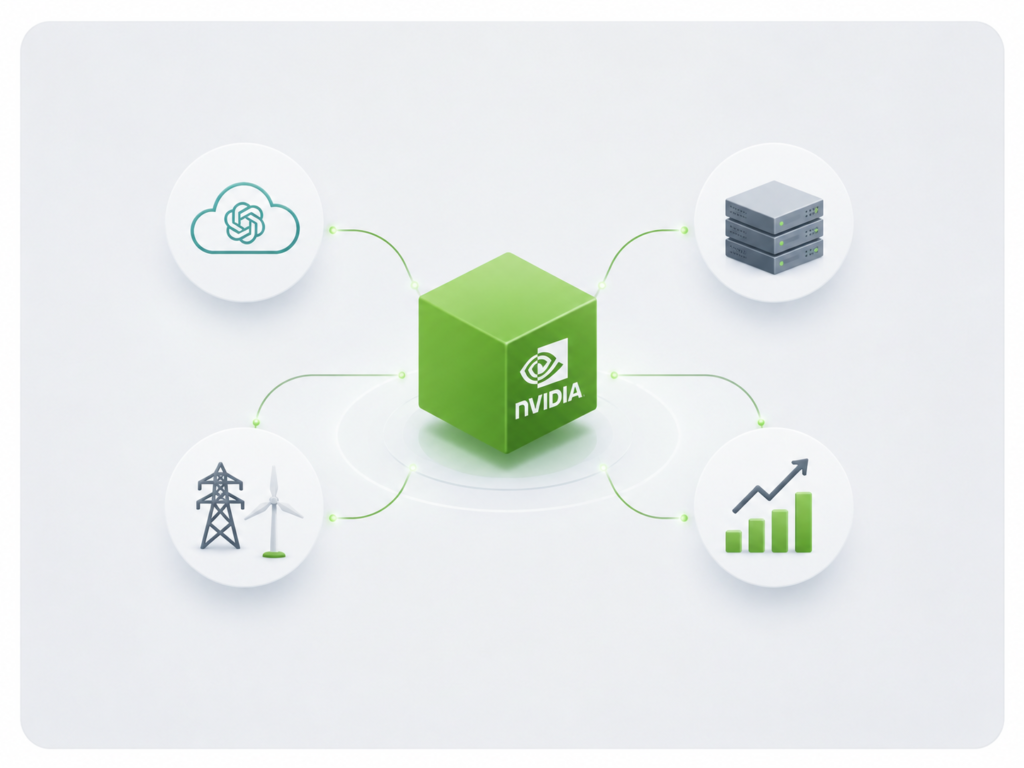
NVIDIA isn’t just selling chips anymore. It’s writing checks, taking equity, and guaranteeing leases for the companies that buy those chips. In the past year its unlisted equity investments rose from about $3 billion to $42 billion, and it just backed a $105 billion lease guarantee for a single Ohio campus. The goal isn’t just moving more GPUs. It’s owning the infrastructure that determines how AI gets built for the next decade.
NVIDIA is no longer only selling chips.
It is writing checks, taking equity, and guaranteeing leases for the companies that buy those chips.
Bankrolling Its Own Customers
In the past year it has put roughly $30 billion into OpenAI, $10 billion into Anthropic, and additional billions into CoreWeave, Nebius, Naver, Lancium, and SoftBank’s SB Energy. Unlisted equity investments rose from about $3 billion to $42 billion in a year.
Last week it joined Apollo, BlackRock, Blackstone, Brookfield, Goldman Sachs, and KKR to create platforms meant to mobilize more than $500 billion of third-party capital for AI factories, with NVIDIA prepared to back a substantial share. This week it agreed to residual-value and lease support of up to $105 billion for an Ohio campus that OpenAI will occupy and that will run only NVIDIA hardware.
Why the Financing Exists
The immediate purpose is to remove the bottleneck that now sits in front of demand. Frontier labs and new AI clouds are growing faster than their balance sheets. Land, power, and long-term credit are scarcer than algorithms. If a customer cannot finance a gigawatt campus, it cannot take the next generation of GPUs.
Vendor financing is an old industrial tactic. NVIDIA is applying it at a scale that turns compute into something closer to an infrastructure asset: long-lived, revenue-producing, and transferable between tenants. Jensen Huang has framed the Ohio deal as securing supply of sites, not manufacturing demand. OpenAI, he notes, pays the lease. The guarantee shrinks as capacity comes online.
What NVIDIA Actually Gets
What NVIDIA gains is more than the next purchase order. Exclusive-chip clauses lock large deployments to its stack for years. Equity stakes give it a claim on the upside if those customers succeed.
Control of sites and power, through investments such as Lancium and SB Energy, keeps the same buildings useful across multiple chip generations instead of becoming stranded assets when a new architecture ships. The $500 billion financing platforms pull institutional capital into NVIDIA-centric projects that hyperscalers might otherwise struggle to put on their own books. Cash that would earn little in treasuries is used to deepen the moat.
The Concentration Risk
It is not only circular bookkeeping, though the criticism is fair. Money that leaves NVIDIA as investment or guarantee can return as GPU revenue. The company has already shown it will trim headline numbers when the optics worsen; the Ohio backstop was discussed at $250 billion and settled at $105 billion.
The risk is concentration: if a few large tenants stumble, both chip demand and residual guarantees are hit at once.
Defensive and Structural
The strategy is therefore both defensive and structural. It keeps the largest customers able to buy chips. It also tries to own the physical and financial rails that determine how much of the next decade’s AI compute can be built at all.
That is an investment in the future of the market, not merely a rebate on last quarter’s sales.