
WHY IT MATTERS
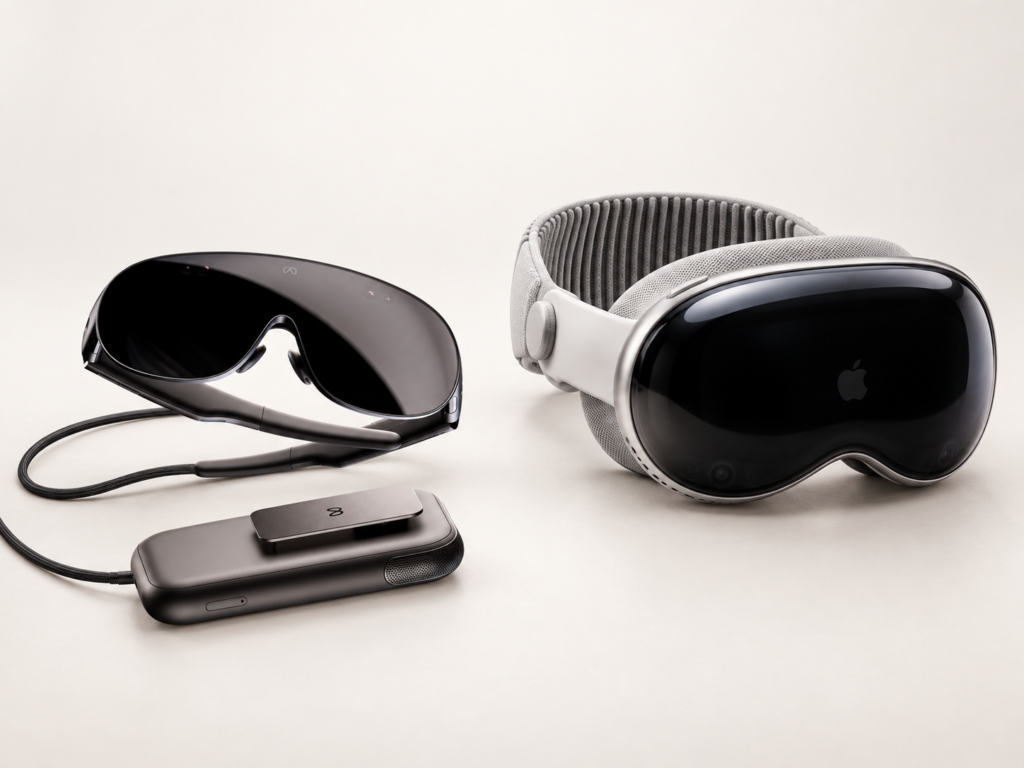
Meta’s new VR Glasses cost less than half of Apple’s Vision Pro and weigh a fraction as much, thanks to a compute puck that solves the headset’s biggest complaint. Based on the demo, this isn’t just a cheaper alternative. It might be the better product.
At Meta Connect 2026, the company unveiled Meta VR Glasses, a lighter, cheaper headset built to go head to head with Apple’s Vision Pro. The pitch is blunt: less than half the price, a fraction of the weight, and reportedly a better experience for the one thing most Vision Pro owners actually do with theirs. Watch movies.
Start with the weight, because it’s the most obvious difference. Vision Pro’s M5 headset weighs 750 to 800 grams (1.62 pounds) on its own, before you add the external battery pack. Meta’s fix: move the processor and associated components out of the headpiece, into a separate puck that also holds the battery. The glasses themselves weigh 100 grams (3.5 ounces), about 7.5 times lighter than Vision Pro’s headpiece alone.
Both devices use micro-OLED displays. Vision Pro’s are bigger, which gives it a 100 degree field of view against 70 degrees on Meta’s glasses. Vision Pro also packs more total pixels per eye, but Meta squeezes its pixels into a smaller screen. Both land in a similar range for pixel density, around the mid to high 30s in pixels per degree. Sharpness should look about the same. You just see less of the world around the image on Meta’s version.
So how much does that narrower view actually change things? Picture a movie playing in an actual auditorium. Vision Pro’s wider view shows more of the room around the screen. Meta’s narrower one fills more of your vision with the screen itself. In a multi-monitor workspace, Meta’s glasses would ask for a bit more head turning to take in everything at once. Neither sounds like a dealbreaker. I don’t think 30 degrees of periphery is worth $2,400.
In work mode, Meta’s headset projects a virtual keyboard and trackpad onto any flat surface, a desk or a kitchen table. If it works as well in daily use as it does in the demo, it beats Vision Pro’s floating keyboard, which still has you pecking at letters suspended in midair.
Meta led with movies, because that’s reportedly what most people are already doing with a Vision Pro. Watching, not working. The glasses are the first IMAX Enhanced certified VR device, with Dolby Vision and Dolby Atmos built in. Vision Pro still has the deeper immersive spatial video library, for now. That lead was built on a two year head start, and it’s the kind of lead that can shrink fast once the $1,299 device starts pulling in additional partners.
Which brings it back to price. Meta VR Glasses: $1,299. Vision Pro: starts at $3,699. That’s less than half the price for a device that’s 7.5 times lighter, with comparable sharpness and a keyboard trick Vision Pro doesn’t have.
None of this is a final verdict. It’s a first look based on a demo, and demos are Meta’s best foot forward, not six months of real world use. But if the experience holds up, this isn’t a scrappy budget alternative to Vision Pro. It’s arguably the better product, at under half the price. Apple built the category. Meta might have out-executed the follow-up.