
BOTTOM LINE
The Gravity GT-S is fast, finished, and aimed at a sliver of the market. Lucid’s real constraint is volume, and the car that could change that is still a year away.
Lucid has a gift for building the car you would buy if money, volume, and timing were someone else’s problem. The Gravity GT-S is the latest exhibit.
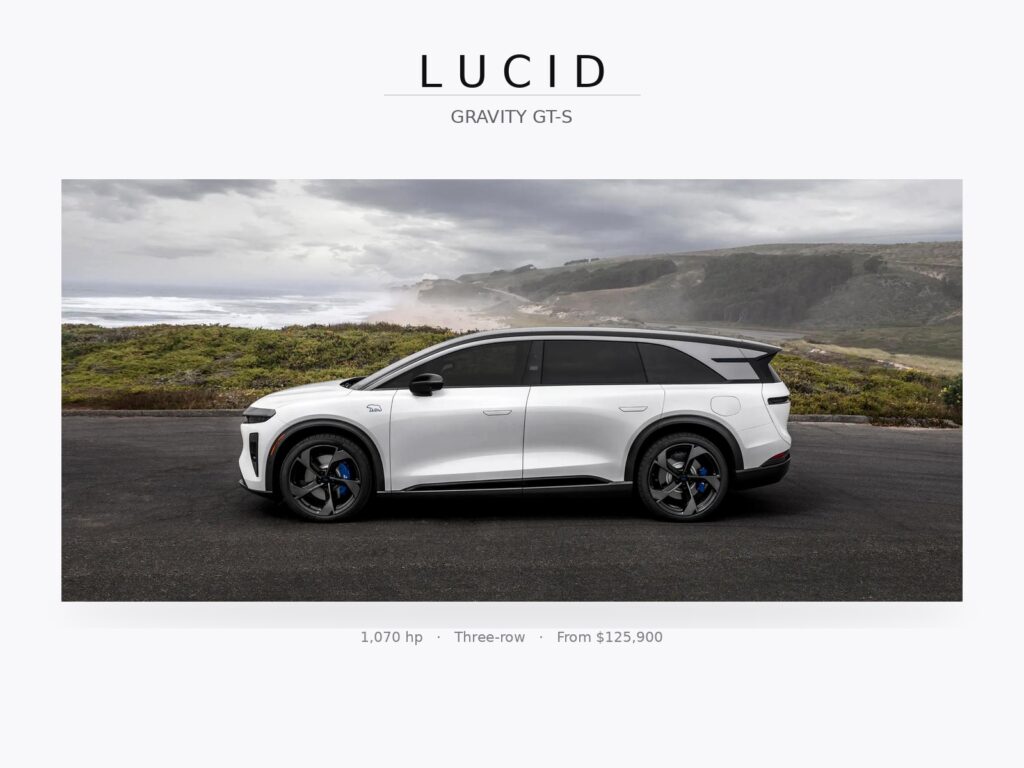
On paper it is almost comic in its competence. America’s most powerful three-row SUV, Lucid says: 1,070 horsepower, 0-60 in a claimed 3.1 seconds, seven seats if you want them, a projected 373 miles of range, and a starting price of $125,900, or about $128,000 once destination is attached. Orders are open. U.S. deliveries are aimed at late 2026. The Dynamic Handling package is standard. This is the old Gravity Dream Edition’s power, recast as a regular top trim and shown, of course, at Monterey Car Week.
None of that is in dispute. The car will be fast. It will be beautifully finished. A small number of people will be delighted.
The question is whether Lucid needed another delighted minority.
The Volume Problem
What Lucid actually needs is volume. That is not a slogan. It is the arithmetic of a company that delivered 3,953 vehicles in the second quarter of 2026, produced 4,774, and cut a production shift in Arizona to match weaker demand. Revenue rose to $405 million, up 56 percent year over year, helped by mix and a richer Gravity share. Mix is not a strategy for filling a factory. Gravity was supposed to be the more popular shape after the Air sedan. It is a better product for more households. It has not turned Lucid into a volume brand. U.S. monthly registrations are below projections, and there are signs the SUV is eating into sedan sales rather than adding a new layer of customers.
Cosmos Keeps Slipping
Against that backdrop, Lucid has already delayed the one product that could change the customer count. The midsize Cosmos, and its sibling Earth, have been pushed from late 2026 into the second half of 2027, with talk of a starting price under $50,000. New CEO Silvio Napoli is explicit about why. Air and Gravity launched too quickly. Quality suffered. He will not “repeat the mistakes of the past.” Fair enough, as an operations decision. As a market decision, it means Lucid will spend another year selling expensive, technically excellent vehicles to a narrow audience while the affordable car waits.
So the GT-S arrives in the gap. A $126,000 performance SUV is not a bridge to $50,000. It is a reminder of who Lucid already is. Halo cars can keep the brand in the conversation and give reviewers something to photograph. They do not, by themselves, create the next ten thousand buyers. Cross-shoppers at this price already have a Rivian R1S Quad and whatever is left of Tesla’s high-power three-row story. Lucid can win the horsepower paragraph. It cannot win 2026 on paragraphs.
Two Stories That Don’t Fit
There is a charitable reading: the GT-S undercuts the old Dream Edition and keeps the Gravity range from looking unfinished while Cosmos slips. But Lucid is also running a cash-conservation playbook: $1.4 billion in identified 2026 cash improvements, a thinner factory schedule, and a public warning that production and deliveries will miss earlier consensus.
Those two stories do not fit together as neatly as a Monterey backdrop suggests. One says protect the mystique. The other says stop building cars the market is not absorbing at the rate the plan assumed. A flagship at $126,000 tells the first story very well. It does almost nothing for the second.
Opinion: Lucid should have let Gravity Touring and Grand Touring do the talking this year and saved the spectacle for a midsize launch that actually moves the demand curve. Quality-first on Cosmos is responsible. Pairing that delay with a new six-figure hero car is a mixed signal.
The GT-S will photograph well. Lucid’s problem was never photography. It was finding enough people who would write the check, and then finding a lot more of them at a lower number. Until Cosmos exists, this is still a niche company with a halo habit. The new SUV is consistent with the habit. It is not a cure for the niche.