
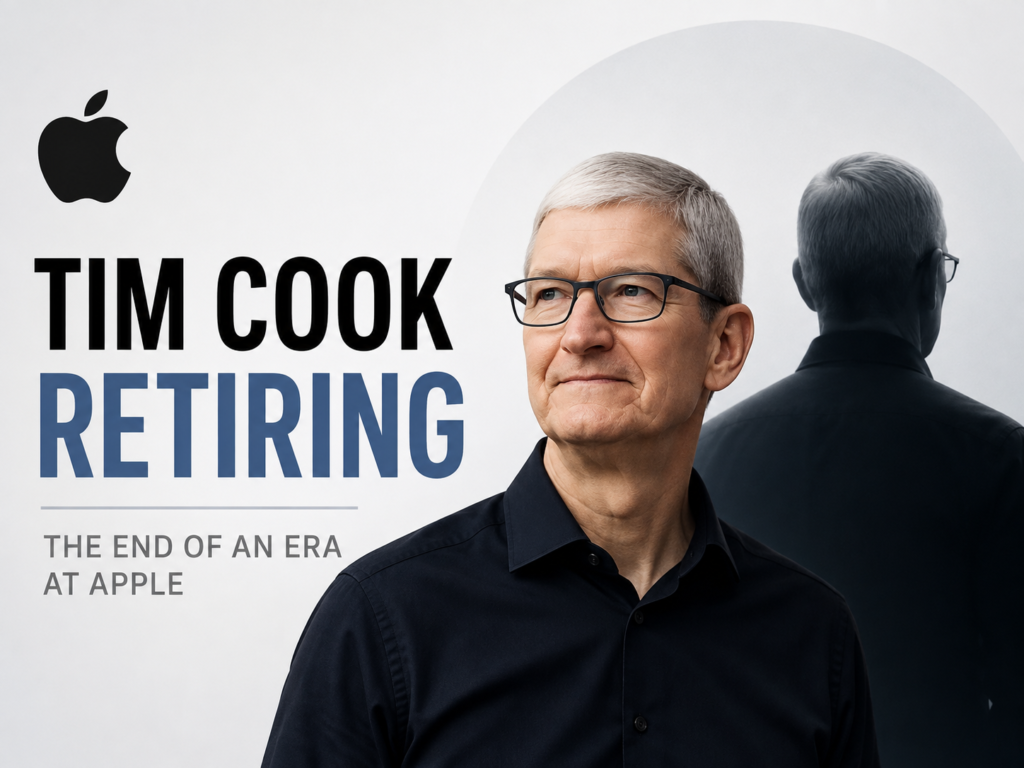
BOTTOM LINE
Tim Cook’s fourteen years as Apple’s CEO end today, with John Ternus, the company’s longtime hardware chief, taking over. Cook never pretended to be the product visionary Steve Jobs was, but he took a $350 billion company and built it into one worth several trillion, all while critics kept asking if Apple could still innovate without him.
Today is Tim Cook’s last day as CEO of Apple. After more than fourteen years running the company Steve Jobs built, Cook is handing the job to John Ternus, Apple’s longtime head of hardware engineering, closing out one of the longest and most consequential tenures in the company’s history.
Cook didn’t ask for the job so much as inherit it under the worst possible circumstances. In August 2011, as Jobs was dying, he handed Cook the company and, according to Cook’s own retelling over the years, a piece of advice that has apparently guided every major decision since: never ask what Jobs would do, just do what you think is right. It’s a strange thing to hand your successor on the way out, a company built entirely around one man’s taste and instinct, paired with permission to stop trying to channel that instinct. Cook listened.
He was never going to be mistaken for a product guy, and he never pretended otherwise. Cook came up through operations, the executive who made Apple’s supply chain one of the most ruthlessly efficient in the world. When he took over, the obvious question wasn’t whether Apple could keep selling iPhones. It was whether a numbers and logistics executive could keep a company alive that had always run on one person’s design sense. For years, that question followed him around every keynote and every product cycle.
The record answers it, even if not everyone agrees on the terms. Under Cook, Apple shipped the Apple Watch, AirPods, the not-so-great Apple Vision Pro, and its own silicon-based Macs, a shift away from Intel that quietly became one of the most important technical bets he made during his tenure. Services grew from an afterthought into a business segment worth tens of billions of dollars a year on its own, giving Apple a second engine that didn’t depend on a single hardware launch landing well. The company Cook took over was worth roughly $350 billion. The one he’s leaving is worth several trillion.
He also made the calls nobody wanted to make. Firing Scott Forstall in 2012, in the aftermath of the Apple Maps launch, was as close as Apple came to a public executive purge under Cook, and it reshaped the leadership team for the following decade. Years later, Jony Ive, the designer most responsible for the physical language of the iPhone and probably the most celebrated industrial designer of his generation, left Apple entirely. Losing the person who defined how Apple’s products looked and felt would have been an existential crisis for a lot of companies. Apple kept growing anyway.
Cook’s fingerprints show up in less obvious places too. During the pandemic, Apple moved its product keynotes to slick, pre-recorded videos instead of live stage presentations, out of necessity at first. They never went back. Apple still holds a live event on launch day, but what plays on the screen inside the Steve Jobs Theater is the same polished recording everyone watches at home, a small, permanent change to how the company communicates that would never have happened under Jobs.
None of that ever fully quieted the innovation question. Critics have spent a decade and a half asking whether Apple under Cook has shipped anything as category-defining as the iPhone itself, versus refining and monetizing what Jobs already built. It’s a fair question, and it’s one Ternus will inherit along with the job.
Ternus is, unlike Cook, unmistakably a product person, the engineer who has shepherded Apple’s hardware for years and is generally seen as closer in temperament to Jobs than Cook ever was or tried to be. Whether that makes him the innovator Jobs was, or whether Apple even needs that kind of innovator again, is a question that will play out in the years ahead.
Whatever anyone thinks about Cook’s ability to innovate, there is no denying his success as a CEO. He took over a great company at a terrifying moment and built it into one of the largest, most profitable companies in the history of business. That part isn’t up for debate.